
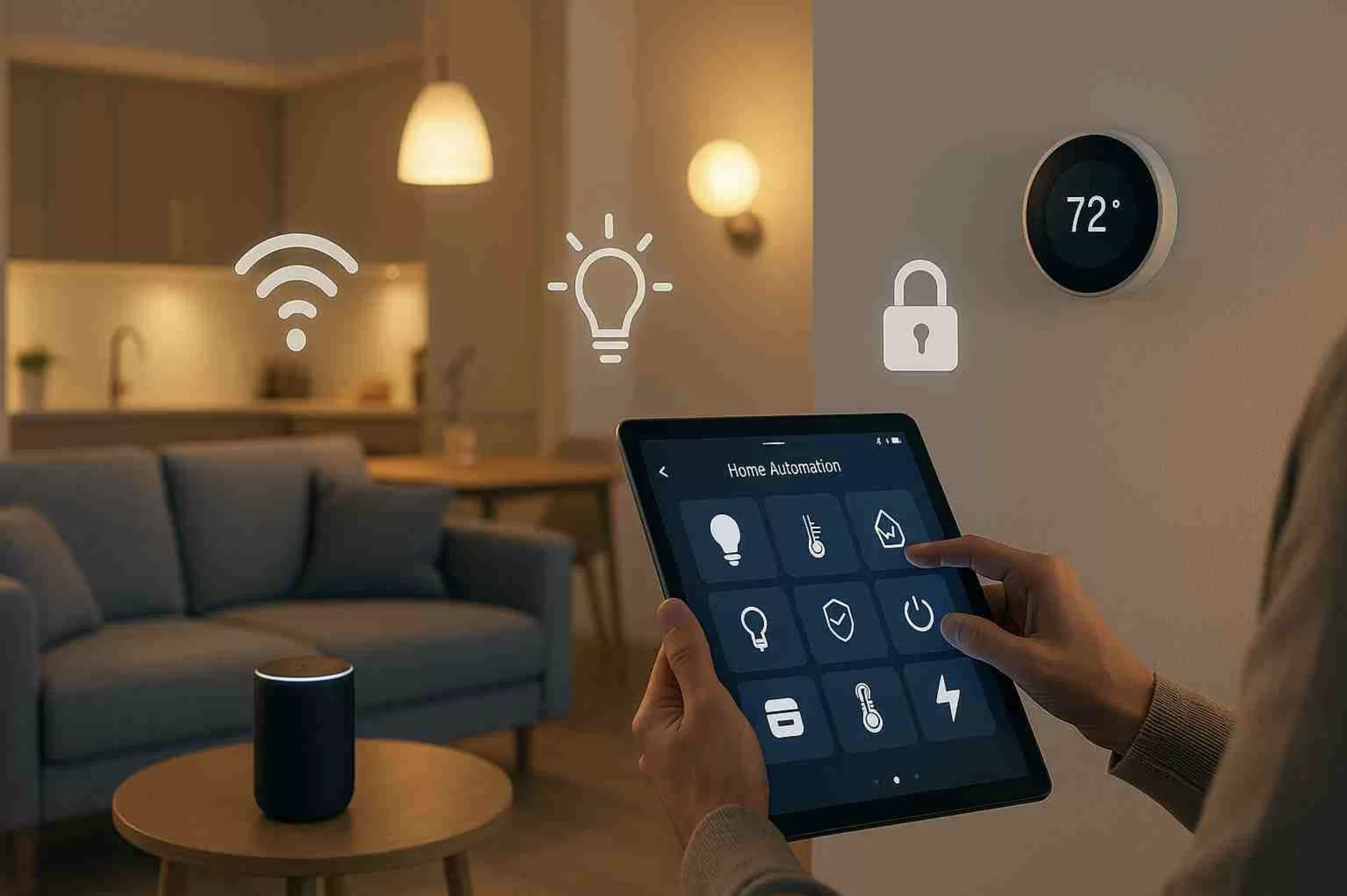
Home Automation Services Cape Town

Home Automation: Making Your Home Smarter and Easier to Manage
Home automation used to be something you would normally associate with expensive homes and futuristic films. These days, it is much more accessible. You don’t need a huge budget or a house full of complicated gadgets to make parts of your home work automatically.
At its simplest, home automation is about getting different parts of your home to do things for you. Lights can switch on without you touching a switch. Blinds can open in the morning. Your security system can react when you leave the house.
And once you start using it, you may wonder why you didn’t do it sooner.
Where does home automation make sense?
Lighting is probably the easiest place to start.
Instead of remembering to switch lights on and off throughout the day, you can set them to follow a routine. Lights could come on when you arrive home, turn off when you leave, or switch on at a certain time in the evening.
The same idea can be used with blinds and curtains. Heating and cooling can also be brought into the system, allowing them to work around your normal routine.
Then there is security.
An outside light could come on when movement is detected. You could receive a notification if a door opens while you’re away. Depending on the equipment installed, you may even be able to check cameras from your phone.
There is no rule saying everything in the house needs to be automated. In fact, starting small often makes more sense.
It isn’t just about convenience
Convenience is obviously a big part of home automation. Nobody is going to complain about having fewer things to remember.
But there can be practical benefits too.
Think about the lights you leave on by accident. Maybe the bathroom light stays on for half the day, or someone forgets to switch off the outside lights. An automated system can take care of these things without anyone having to think about them.
The same applies to other equipment around the home.
You can set up routines that suit the way your household actually works. When everyone leaves in the morning, for example, selected lights and appliances can switch off while the security system is activated.
When you get home, some of those settings can change again.
It saves time, but more importantly, it means you don’t have to keep remembering all those little jobs.
Start with what you actually need
One of the advantages of home automation is that you don’t have to do everything at once.
You might only be interested in lighting to begin with. Later, you could add automated blinds, security equipment or better control of your heating and cooling.
That is why it is worth thinking about the bigger picture before buying individual devices.
A smart device might work perfectly on its own, but that doesn’t necessarily mean it will work with everything else you want to add later. Choosing equipment that can communicate with the rest of your system can save you from replacing things further down the line.
A little planning at the start can make a big difference.
Controlling your home when you’re away
Being able to control your home from your phone is another useful part of a home automation system.
Imagine you’re already halfway to work and suddenly wonder whether you left a light on. Instead of turning around, you can check your system and deal with it from your phone, provided the equipment supports remote access.
It can be handy when you’re away for longer too.
If you’re going on holiday, for example, you can check certain parts of your home while you’re away. You could also use lights at different times to make the house look occupied.
The exact options will depend on the system and equipment you choose, so it is worth looking at what you actually need rather than buying every smart device you can find.
Home automation doesn’t have to be complicated
There is a common idea that a smart home means having screens everywhere, dozens of apps and a complicated control panel that nobody knows how to use.
It doesn’t have to be like that.
A well-planned home automation system should make things easier, not harder. The technology should fit around the way you live rather than forcing you to change your daily routine.
For some homes, that might mean simple lighting control. For others, it could include security, blinds, heating, cooling and several other systems working together.
The important thing is to start with what will actually make life easier.
Home automation is not really about having the most technology in your house. It is about getting your home to do some of the everyday jobs for you.